
Sleep foundations
REM and Deep Sleep: What Happens While You Rest?
A closer look at the stages of sleep, why the whole night matters, and how to read sleep-tracker numbers with perspective.
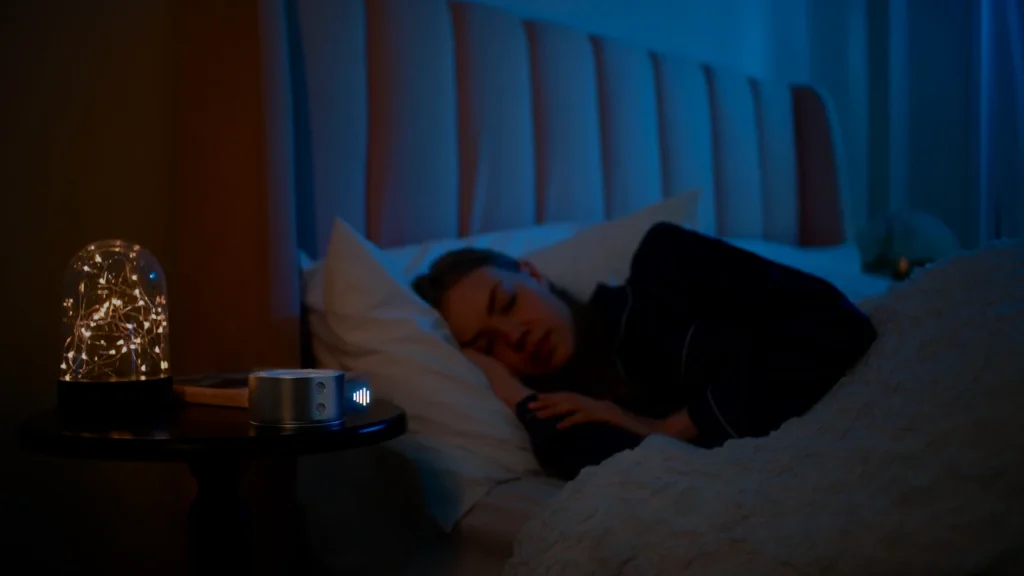
You can wake after a night of sleep with very little memory of it. Yet sleep is not one unchanging state. Through the night, you move between non-REM and REM sleep, with different patterns of activity in each. Deep sleep is one part of that process; it is not another name for REM. 1
Understanding the difference can make a sleep chart less mysterious. It can also take some pressure off the idea that you need to maximize one stage. A healthy night involves a sequence of stages, not a competition between them.
First, separate REM from deep sleep
Non-REM sleep has three stages, usually called N1, N2 and N3. N3 is deep sleep, also called slow-wave sleep. REM stands for rapid eye movement. It is a distinct phase in which the eyes move rapidly and measured brain activity becomes more similar to waking activity. Most muscles normally become very relaxed during REM. 1
The names describe states researchers identify through measurements, not how impressive a night feels. “Light” sleep does not mean you failed to sleep. “Deep” does not mean every other stage is unnecessary. If an app puts these labels into colored bands, the colors are representing different parts of sleep rather than grades.
N1 / N2
Lighter non-REM sleep
The transition into sleep and lighter sleep.
N3
Deep non-REM sleep
Usually more prominent earlier in the night.
REM
Rapid eye movement sleep
More prominent later in the night; much dreaming occurs here.
The stages you pass through
N1: crossing into sleep
N1 is the transition from being awake to being asleep. It is a relatively light stage. This is the beginning of the change in state, rather than a separate activity you need to perform correctly before sleep can happen. 1 2
N2: lighter sleep is still sleep
N2 is a period of light sleep before deeper sleep. Seeing lighter sleep on a chart should not, by itself, be discouraging: it belongs within the normal stages of the night. The label is a physiological description, not a judgment about whether the time counts. 2
N3: deep sleep
N3 gets its slow-wave name from a pattern measured during sleep studies. You generally spend more time in this stage earlier in the night. As people age, the amount of slow-wave sleep commonly decreases, so a younger person’s chart is not a useful personal target for every adult. 1
REM: a different kind of activity
Dreaming often occurs in REM sleep. REM tends to occupy more of the later part of the night. That is one reason the final hours should not be treated as disposable just because you have already slept through the first few. 1
A night changes as it goes
The NHLBI describes cycles that usually restart approximately every 80–100 minutes, with about four to six cycles over a night. Brief awakenings can happen between them. These are general patterns, not a timetable you can set your watch by. 1
Imagine two people with the same morning alarm. One consistently leaves enough time for a full night; the other cuts the night short to finish work. The second person cannot know which stages they are losing simply by dividing the available time into 90-minute blocks. A cycle calculator does not measure what their body is doing.
Likewise, an early awakening does not let you calculate exactly how much REM or deep sleep you missed. The useful action is to look at the overall sleep opportunity and any repeated disruption. Trying to reconstruct every minute can produce a very detailed explanation from information that is not actually available.
Why the whole night matters
Sleep supports learning and memory through several processes. NIH describes research connecting deep sleep with stabilizing memories and REM with linking related memories and processing emotional experiences. That work points to the value of a full night, rather than a single stage that does everything. 3
For someone learning a language, practicing music, or taking in a difficult day at work, the practical choice is to protect time for sleep around that learning. There is no need to turn an evening into a strategy for manufacturing one kind of sleep. The basic opportunity to rest is something you can plan; the exact stage sequence is not something you consciously direct.
What a wearable’s stage numbers can tell you
A clinical sleep study identifies stages using signals that include eye movements and brain activity. Consumer devices use their own measurements and algorithms, so the stage number on a wrist or bedside display should be understood as an estimate. 1 4
In a 2021 laboratory study, researchers compared seven consumer sleep trackers with polysomnography in 34 healthy young adults. Several devices performed well at identifying sleep, but stage assessments were inconsistent. Those results describe the devices tested at that time; they do not establish the accuracy of every current model. 4
If you use a tracker, ask what you want the information to help you do. Noticing that bedtime keeps slipping is actionable. Deciding that a particular deep-sleep total means something is wrong requires much more context.
- Look at repeated patterns rather than reacting to one night’s chart.
- Keep your own experience in view: sleep opportunity, remembered interruptions, and daytime alertness.
- Do not compare scores from different people or devices as though they were interchangeable measurements.
- If the numbers concern you, bring the record and your symptoms to a healthcare professional.
The AASM’s position on consumer sleep technology emphasizes that these tools need appropriate validation and clinical context. A device report should not replace an assessment of an ongoing sleep concern. 5
Give the night room to unfold
You do not need to remember dreaming to appreciate REM, or see a large deep-sleep bar to take the rest of your night seriously. Start with what you can change: enough time, fewer preventable interruptions, and attention to difficulties that keep returning.
Use the stages to understand sleep. Let your own nights be nights of rest, rather than a series of targets to achieve before morning.
Sources
1. NHLBI. How Sleep Works: Sleep Phases and Stages.
2. NINDS. Brain Basics: Understanding Sleep.
3. NIH News in Health. Sleep On It: How Snoozing Strengthens Memories (2013).